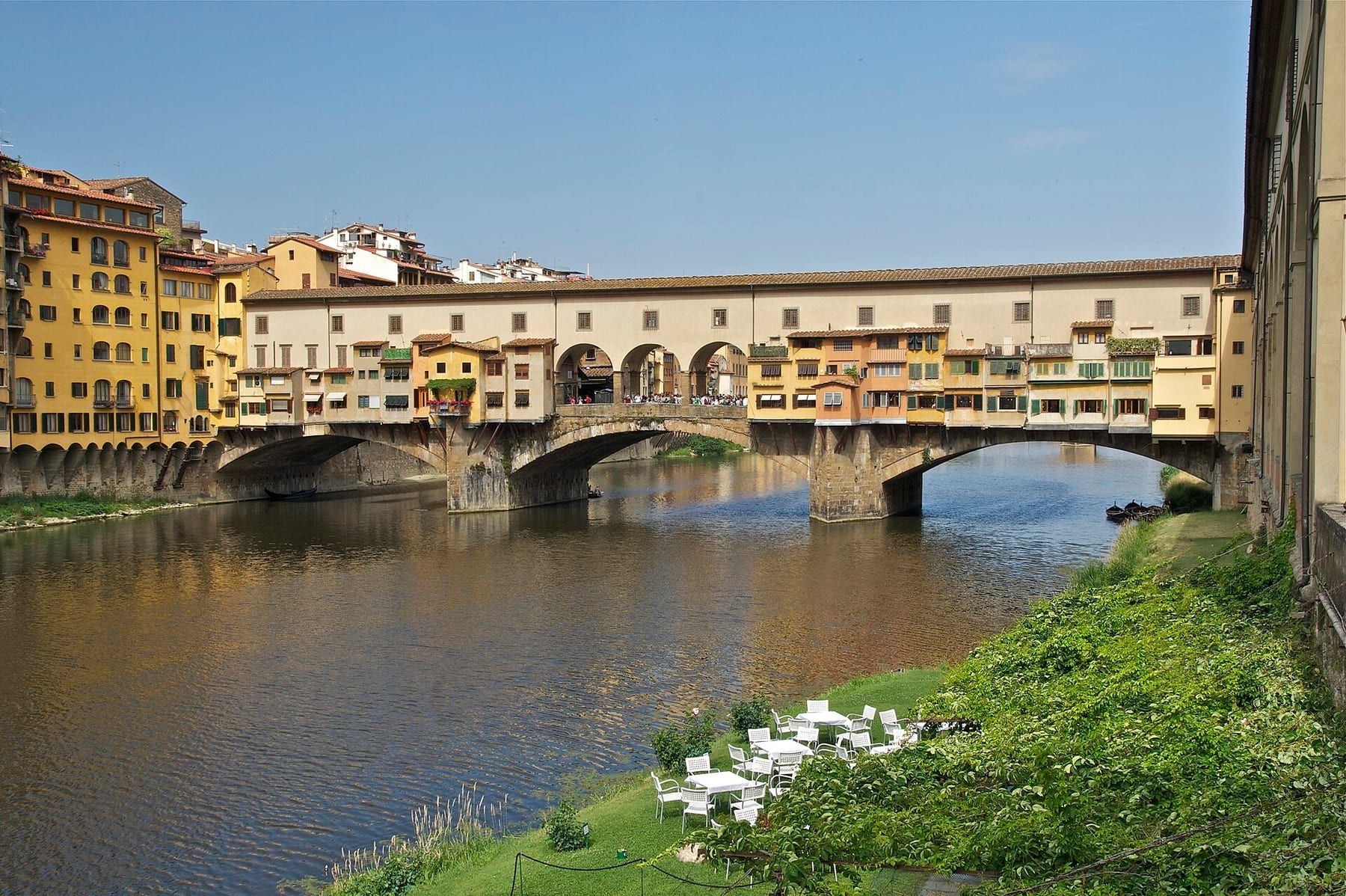
Ponte Vecchio has no ticket office, no opening hours and no queue: you cross it free at any hour, every day of the year. The only thing you pay for is what runs above the shops, the Vasari Corridor, which can only be visited together with the Uffizi Gallery at €43 for the same day and €47 with an advance date, according to uffizi.it. Here you will find how to get there, the right hour for photos, what to expect from the goldsmiths’ shops and which paid experiences actually make sense.
Free, always open, no booking
The bridge is a public street: no turnstile, no ticket, no closing time. You can walk across it at night too, when the wooden shutters of the shops are down and the paving empties out.
The only restrictions are exceptional and decided by the city council for public order — on New Year’s Eve, for instance, the bridge can be closed or access limited. If you are in Florence on those dates, check the council notices before planning a midnight photo.
Two things to expect. The bridge is barely wider than a traffic lane and between 11:00 and 18:00 it becomes a funnel. And there is no place to stand: anyone stopping to take pictures in the middle of the flow blocks everyone. The three central openings, either side of the Cellini bust, are the only spot where you can lean on the parapet.
The bridge connects the centre to the Oltrarno: from here you are three minutes from Pitti Palace, two from Palazzo Vecchio and one from the entrance to the Uffizi.
From 1345 to the goldsmiths: the history in five lines
The present bridge was built in 1345, after the 1333 flood destroyed the previous one. The architect’s name is not settled: Vasari attributed it to Taddeo Gaddi, while much recent scholarship leans towards Neri di Fioravante, and no document closes the question. It has three flattened arches, an unusual technical solution for the time, and it was built from the start with shops along both sides: renting out the stalls was city income.
For two centuries the stalls belonged to butchers, fishmongers and tanners, who threw their waste straight into the Arno. In 1593 Grand Duke Ferdinando I de’ Medici threw them all out and assigned the shops to goldsmiths and silversmiths.
The reason was practical rather than aesthetic: the grand dukes’ private corridor ran over the butchers’ heads, and the smell reached it. The trade has not changed since: the bridge sells gold, silver and stones, and nothing else.
In the middle of the bridge, on the terrace open towards upstream, stands the bronze bust of Benvenuto Cellini, goldsmith and sculptor, with its fountain. It is the meeting point of meeting points, and the railing around it is the one that collected padlocks for years.
The Vasari Corridor runs above the shops
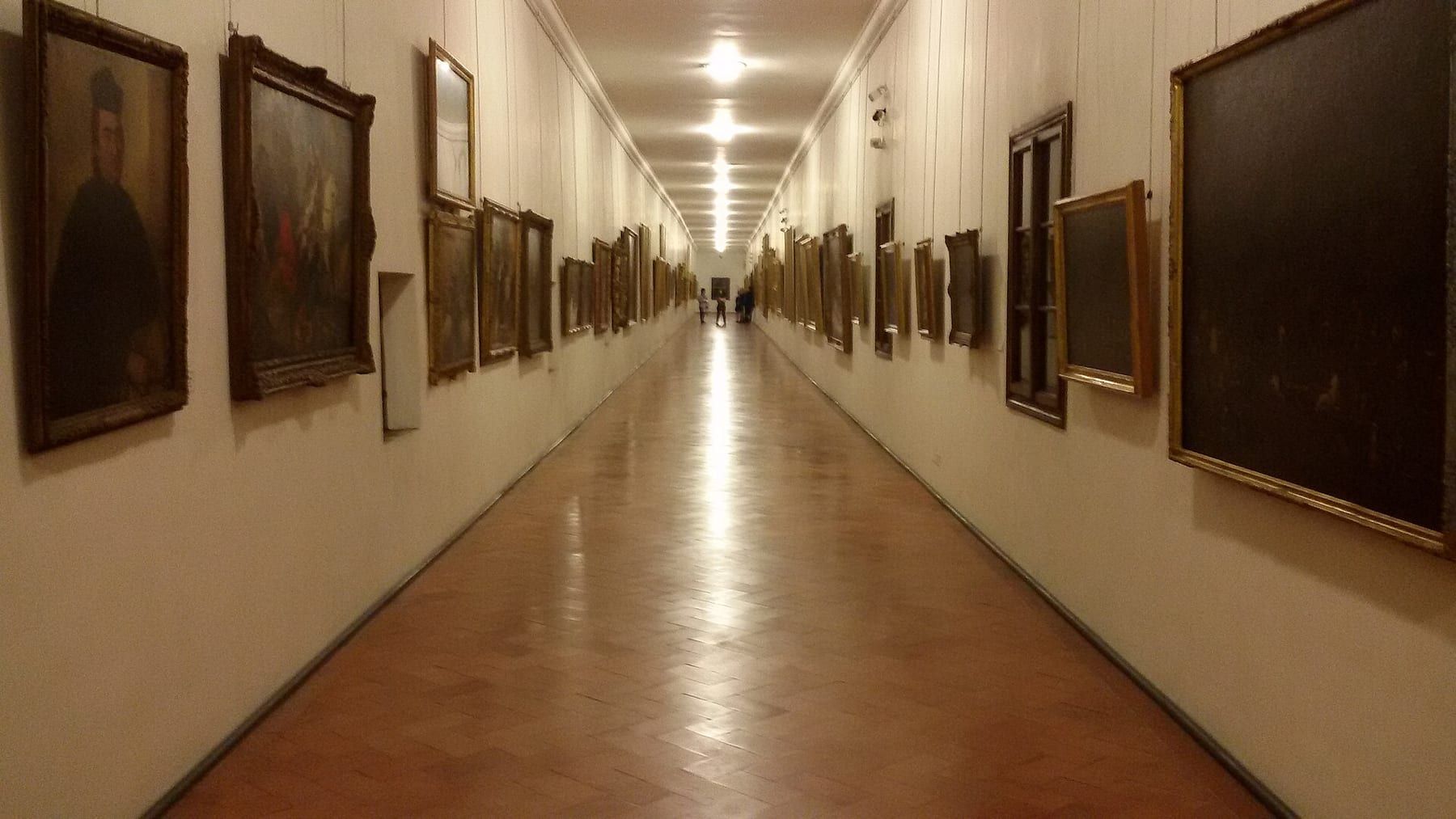
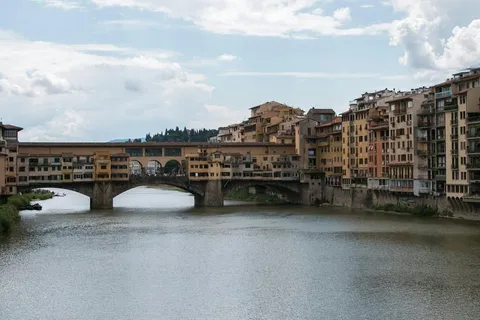
That row of small windows above the jewellers, on the upstream side, is the Vasari Corridor: roughly a kilometre of covered passage linking the Uffizi to Pitti Palace over the bridge. Giorgio Vasari built it for Cosimo I, and it reopened to the public on 21 December 2024 after a long restoration.
It cannot be visited on its own. The ticket is combined with the Uffizi Gallery and works in time slots.
| Option | Official price | What it includes | Notes |
|---|---|---|---|
| Uffizi + Corridor, same day | €43 | Gallery + 45-minute route | reduced €2 (EU 18–25) |
| Uffizi + Corridor, advance date | €47 | as above | the difference is the booking fee |
| Supplement for PassePartout or Firenze Card | €20 | Corridor only | €2 for reduced-rate holders |
| Friday evening opening | €20 same day / €24 in advance | Corridor only, 19:00–23:00 | from 3 July to 20 November 2026, last entry 21:50 |
Prices according to uffizi.it. The practical rules matter as much as the price: you must enter the Gallery two hours before your Corridor slot, the meeting point is room D19 on the first floor and you have to be there five minutes early, or you lose your right of access. The route is one-way, takes about 45 minutes, comes out at the Buontalenti Grotto in the Boboli Gardens, and there is no re-entry to the Uffizi.
The ticket is name-bound, non-changeable and non-refundable, and booking is compulsory for everyone, including children under six. It is not a guided tour: staff escort you, they do not narrate. Tiqets and GetYourGuide sell Uffizi + Vasari Corridor packages that cost more than the official price but hold slots when tickets.uffizi.it is sold out.
Why the bridge was not blown up in the war
In August 1944, retreating north, German troops mined every bridge in Florence. Ponte Vecchio was the only one spared.
Instead they blew up the medieval buildings at both ends — via Guicciardini on one side, Borgo San Jacopo and via dei Bardi on the other — so that the crossing would be impassable to vehicles anyway. That is why the houses around the bridge look like reconstructions: they are.
Who took the decision, and why, is still argued over: it has been credited in turn to a direct order from Hitler and to the intervention of the German consul in Florence, Gerhard Wolf, with no decisive document either way. The fact stands: the bridge you are walking across is the fourteenth-century one, while the blocks on either side are post-war.
Padlocks are banned, and what getting it wrong costs
Love locks on the Cellini railing are forbidden. Article 4 of the City of Florence urban policing regulation prohibits fixing keepsakes to walls, lamp posts, fences and the protective barriers of monuments; the word “padlocks” does not appear, but the ban covers them. The penalty is the general one in article 42: €80 to €500, in practice settled with a reduced payment of €160. Council workers cut them off in waves, along with the damaged stretch of railing.
The other temptation is far more expensive: carving or writing on the parapet. Since graffiti on cultural property has carried administrative fines in the tens of thousands of euros, the City of Florence has already fined foreign visitors five-figure sums. This is not an anecdote: it is an official press release.
Common-sense rule: on the bridge you walk, look and photograph. You do not attach, you do not carve and you do not sit on the parapet.
When to photograph Ponte Vecchio
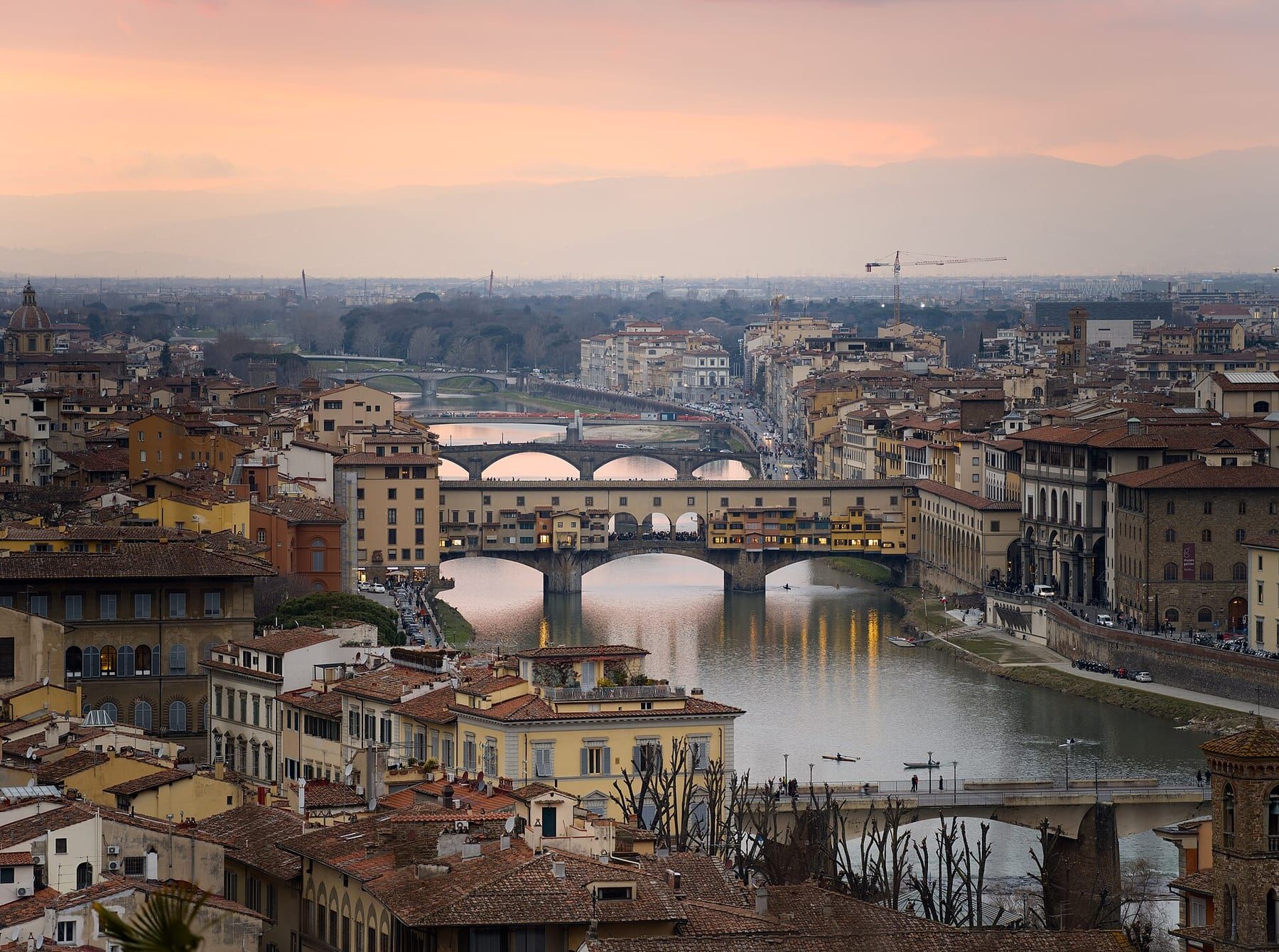
At dawn, from the bridge itself or from Lungarno degli Archibusieri: the bridge is empty, the light is low and there is nobody in the frame. It is the only window in the day when you can stop in the middle without getting in anyone’s way.
At sunset, from Ponte Santa Trinita, the next bridge west: this is the classic position, the one with the bridge in profile and the sun dropping behind the hills. It is a three-minute walk and in the last half hour of light it is crowded — get there early and take your place on the Oltrarno side of the parapet.
From above, from Piazzale Michelangelo: the bridge is small in the frame but it sits inside the full panorama with the Dome and the Bell Tower. You need a telephoto lens to isolate it.
From below, from Lungarno Torrigiani or from a boat: this is the angle that shows how the shops hang out over the water on wooden brackets.
Arno cruises on the barchetti
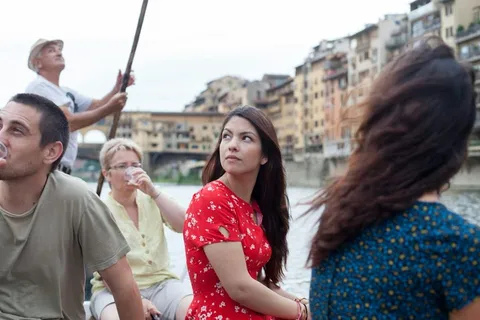
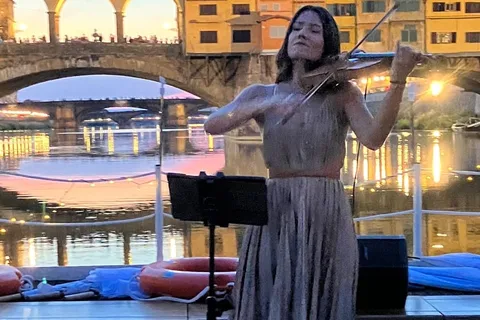
The barchetti are the traditional flat-bottomed boats of the Arno sand dredgers, rowed or run on an electric motor. They pass under the arches of Ponte Vecchio and last about 50 minutes. It is the only way to see the bridge from water level, and on hot days it is also the most restful.
The two formats on the market are the plain cruise and the one with a live concert on board. Always check the boarding point: it changes from operator to operator and it is written on the voucher, not on the product page.
-
from €59.52 per person
Book on Tiqets -
from €36 per person
Book on GetYourGuide -
from €92 per person
Book on Tiqets
The goldsmiths’ shops and some sense about prices
Three very different categories share the bridge. There are the historic workshops with a bench at the back, often family-run, working gold to order and stamping their maker’s mark on the pieces. There are the high-end jewellers with windows straight out of a luxury mall. And there are the souvenir counters selling lightweight chains at airport prices.
Three checks worth more than any haggling. Ask for the gold standard (750 for 18 carat) and look for the hallmark. Ask whether the piece was made in the workshop or bought wholesale: it changes both the price and the value. And ask for an invoice, which you need for the guarantee and, if you live outside the European Union, for the VAT refund.
There is no local price list: gold is paid by weight plus the work, so a plain ring in a shop on the bridge does not necessarily cost more than one in the centre. What you pay extra for is the address, and you pay it above all on small impulse pieces.
Nearby
Fifty metres from the northern end is the entrance to the Uffizi Gallery, and on the other side of the bridge, three minutes away, Pitti Palace and the Boboli Gardens, where the Vasari Corridor ends. Walking up towards Piazza della Signoria you reach Palazzo Vecchio and the Loggia dei Lanzi, both free to see from the outside.
If you are putting an itinerary together, the things to do in Florence page sorts out travel times, while the comparison between passes and single tickets is on the Florence tickets page and in the guide to Tiqets combo tickets.
Ponte Vecchio is still the most photographed thing in Florence and it costs nothing: the only spending that makes sense is what takes you above it — the Vasari Corridor — or below it, in a boat.
Frequently asked questions
Do you have to pay to cross Ponte Vecchio?
No. Ponte Vecchio is a public street: you cross it free, with no ticket and no booking, 24 hours a day, every day of the year. The only paid part is the Vasari Corridor, which runs above the shops and can only be visited with an Uffizi ticket.
How much does the Vasari Corridor cost?
The Uffizi + Corridor ticket costs €43 if you buy it for the same day and €47 with an advance date, reduced to €2 for EU citizens aged 18 to 25, according to uffizi.it. If you already hold a PassePartout or the Firenze Card, you pay a €20 supplement.
What is the best time to photograph Ponte Vecchio?
At dawn the bridge is almost empty and the light comes from upstream. At sunset the classic shot is taken from Ponte Santa Trinita, the next bridge to the west, with the sun dropping behind the hills: half the city queues up there, so arrive twenty minutes early.
Why are there only jewellers on Ponte Vecchio?
Because in 1593 Grand Duke Ferdinando I de' Medici ordered the butchers and tanners out and replaced them with goldsmiths and silversmiths. The stated reason was the smell: the Vasari Corridor, used by the grand ducal family, passed above the shops.
Is it true that Ponte Vecchio was not blown up during the war?
Yes: in August 1944 it was the only bridge in Florence the retreating German troops did not destroy. Instead they mined the medieval buildings at either end, in via Guicciardini and Borgo San Jacopo, to block the crossing anyway — which is why the houses around the bridge are post-war rebuilds.
Can you still attach love locks to the railing?
No. Article 4 of the City of Florence urban policing regulation forbids fixing keepsakes to walls, lamp posts and the protective barriers of monuments, and article 42 punishes the breach with an administrative fine of €80 to €500, settled in practice at a reduced €160. Council staff periodically cut off the padlocks attached to the railing around the Cellini bust.
How long is an Arno boat cruise?
Trips on a traditional flat-bottomed barchetto last about 50 minutes and pass under Ponte Vecchio. Tiqets and GetYourGuide both sell the plain cruise and the version with live music on board: the exact meeting point is on your voucher.
What is the worst time to go?
Between 11:00 and 18:00, and above all at the weekend: the bridge is barely wider than a traffic lane and turns into a funnel. If you are short of time, walk across early in the morning and come back to look at it from a distance at sunset.